
Why Do Children Struggle with Maths? The Hidden Causes of Maths Fear
November 26, 2025 2025-11-26 11:53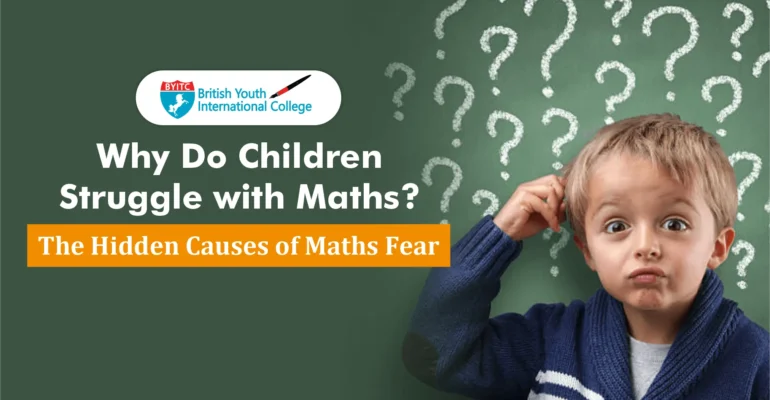

Many children struggle with maths, not because they are lazy, but because hidden barriers make it hard to understand the subject and trust themselves. When fear and frustration build, these kids’ maths struggles can become a self-reinforcing cycle.
Mathematics is often called the “queen of the sciences,” yet for many learners it evokes dread, confusion, and frustration. Children struggle for many reasons beyond “not practising enough.” Let’s explore the hidden causes behind kids’ maths struggles and the fear that holds them back.
Common Reasons Children Struggle with Maths
Early negative experiences can leave a lasting fear
For many children, difficulties begin with their earliest encounters with numbers. A simple mistake in class, being shamed for a wrong answer, or being compared to peers can leave a deep mark. These moments teach children to equate errors with failure rather than learning. Over time, this creates anxiety whenever they even think about maths.
Teaching style and speed pressure
A lot of children Struggle with Maths because of how maths is taught. Traditional approaches often emphasise speed, memorisation, and rote procedures instead of understanding. When timed tests, fixed pacing, and standardised drills dominate, children who need more time or different explanations can quickly fall behind.
The influence of parents, teachers, and culture
Children pick up far more than what’s on the board.
- Kids maths struggles are due to parental attitudes: When a parent often says, “I was never good at maths,” or shows anxiety around numbers, children absorb that message. Research links parents’ maths anxiety to lower early numeracy in children.
- Teacher behaviour: Teachers who rush explanations, discourage questions, or prioritise correct answers over the process can unintentionally create a hostile environment.
- Cultural myths: The idea that you’re either “a maths person” or you’re not promotes a fixed mindset. This makes struggles feel like a personal flaw rather than a skill gap that can be closed with support and practice.
Emotional and psychological factors
What’s happening inside a child matters just as much as what happens in the classroom.
- Low self-esteem and negative self-talk: When children repeat “I’m not good at maths,” it can become a self-fulfilling belief. Children Struggle with Maths when they fear it.
- Anxiety and physical symptoms: Maths fear isn’t abstract. It can show up as a racing heart, panic, going blank, or wanting to avoid maths entirely. These reactions make learning harder and drive avoidance.
- Low frustration tolerance: Without strategies or support, some children give up when problems get tough, which widens gaps and deepens fear.
How to help: breaking maths fear and building confidence
- Encourage a growth mindset. Praise effort, strategies, and persistence, not just correct answers to reduce kids maths struggles.
- Create safe spaces for error. Model that mistakes are part of learning, not signs of failure.
- Connect maths to real life. Use stories, visuals, games, and hands-on objects to make ideas concrete.
- Reduce speed, pressure and comparisons. Allow time to think. Avoid harshly timed drills and discourage comparing children to one another.
- Involve parents supportively. Caregivers can foster positive attitudes toward maths rather than passing along their own anxiety.
- Equip teachers. Provide training and resources to recognise maths anxiety, use diverse teaching styles, and emphasise conceptual understanding over speed.
- Include abacus maths. The abacus helps children visualise numbers, develop mental arithmetic, improve concentration, and build speed with confidence. BYITC, for example, offers abacus programmes that strengthen mental maths foundations. British Youth International College
- Try structured programmes. BYITC integrates abacus methods and other supports to help students build calculation skills and reduce maths anxiety.
Conclusion
Kids maths struggles are simply not because it’s “hard.” Emotional, cognitive, social, and instructional factors all play a part in creating maths fear. When we understand these root causes and address them early, we can help children move from anxiety to curiosity growing into confident, capable learners who see maths as a subject they can understand and enjoy.
Related Articles
How to Choose the Best Maths Programme for Your Children?
How can Abacus Classes unlock counting brilliance at your fingertips?
“The Power of Play”: How Game Based Maths Learning Improve Concentration in Children
Enhancing Mathematical Skills: The Benefits of Abacus Maths Classes for Children
Abacus Maths Classes in Delhi | Abacus Classes in Bangalore | Abacus Mental Maths in Hyderabad | Online Abacus Classes in Ahmedabad | Abacus Maths Near Me | Abacus Maths Online Near Me | Abacus Class in Mumbai | Abacus in Surat | Abacus for Kids Near Me | Abacus Tuition Near Me in Jaipur | Abacus Online in Lucknow | Abacus tutor in Kanpur | Abacus class near me in Nagpur | Abacus near me in Indore | Best Online Abacus Classes in Thane