The Benefits of Mental Maths: Sharpen Your Mind and Build Confidence
August 21, 2026 2026-08-21 9:46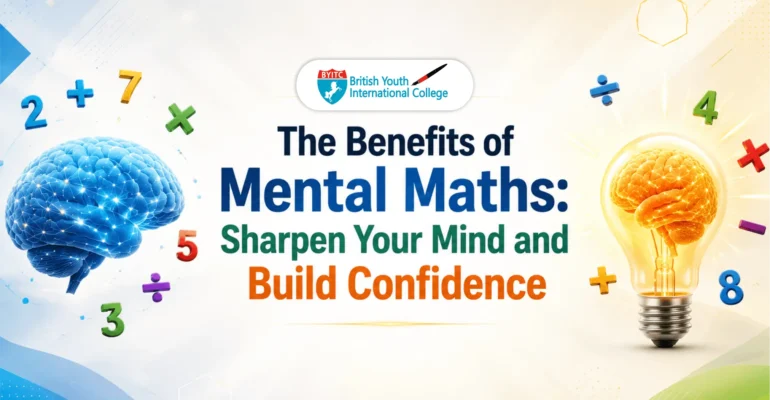

Benefits of Mental Maths go far beyond the ability to solve calculations quickly. Developing strong number skills can help children improve concentration, memory, logical reasoning, problem-solving abilities, and confidence. It can also make everyday calculations easier and encourage children to approach challenges with a more positive mindset.
In a world where calculators and smartphones can solve problems instantly, learning to work with numbers independently remains an important skill. Regular practice can help children understand numbers better while developing cognitive abilities that can benefit them both inside and outside the classroom.
What Is Mental Maths and What Are the Benefits of Mental Maths?
Mental maths is the ability to perform calculations in your head without immediately depending on a calculator, paper, or digital device. It includes activities such as addition, subtraction, multiplication, division, percentages, estimation, and number comparisons.
The purpose is not simply to make children calculate faster. It is about helping them understand numbers, recognise patterns, choose efficient strategies, and think logically when solving problems.
With regular and age-appropriate practice, children can gradually become more comfortable with numbers and develop a stronger foundation for mathematical learning.
1. Improves Concentration and Focus
Solving calculations mentally requires children to pay close attention to the numbers and steps involved. They may need to remember a number, perform an operation, and keep track of the result without writing everything down.
This type of activity encourages children to stay focused and process information carefully. Stronger concentration can also support other areas of learning, including reading, writing, studying, and completing school assignments.
2. Strengthens Memory
Mental calculations often require children to hold information in their minds while completing several steps. This can provide regular practice for working memory.
For example, when solving a calculation involving multiple operations, a child may need to remember an intermediate answer before continuing. Repeated activities like these can encourage children to retain and process information more effectively.
A stronger working memory can be useful across different subjects and everyday situations.
3. Develops Problem-Solving Skills
One of the most valuable aspects of working with numbers mentally is learning that there can be different ways to reach the same answer.
Children begin to identify patterns and shortcuts instead of relying on a single method. They may learn to break a difficult calculation into smaller parts or use simpler numbers to make a problem easier.
This encourages flexible thinking and can help children approach unfamiliar problems with greater confidence.
4. Builds Confidence in Mathematics
When children struggle with numbers, they may become hesitant to participate in mathematics-related activities. Successfully solving a calculation can create a sense of achievement and encourage them to keep trying.
As children practise and see their progress, they may become more comfortable answering questions and attempting challenging problems.
This gradual improvement can help replace the fear of making mistakes with a willingness to learn from them.
5. Encourages Logical and Analytical Thinking
Mathematics involves much more than memorising formulas. Children also need to understand relationships between numbers, identify patterns, compare values, and make decisions.
For example, understanding that 25 × 4 equals 100 can help children recognise useful number relationships. Similarly, adding 99 can be made easier by adding 100 and subtracting 1.
These simple strategies encourage children to think about why an answer works rather than simply memorising it.
6. Makes Everyday Calculations Easier
Number skills are useful in many everyday situations. Children encounter numbers when shopping, telling time, measuring ingredients, comparing prices, calculating distances, and managing money.
Being comfortable with basic calculations can help them make quick estimates and understand numerical information without always reaching for a calculator.
These practical skills can contribute to greater independence as children grow.
7. Encourages a Positive Learning Habit
Learning does not always need to involve textbooks and worksheets. Number-based games, puzzles, challenges, quizzes, and everyday activities can make practice more engaging.
When children regularly interact with numbers in enjoyable ways, they can begin to see mathematics as something practical and interesting rather than simply another school subject.
Short, consistent practice can also be easier to maintain than long and stressful study sessions.
How Can Parents Encourage Number Skills at Home?
Parents can introduce simple numerical activities into everyday routines without making them feel like formal lessons.
For example, ask your child to estimate the total cost of a few grocery items, calculate how much change they should receive, work out how many minutes remain before an activity, or solve a quick number puzzle.
Games and challenges can also make practice more enjoyable. The focus should be on encouraging curiosity and reasoning rather than putting pressure on children to answer every question immediately.
Consistency is important. A few minutes of enjoyable practice each day can help children gradually become more confident and comfortable with numbers.
Conclusion
The Benefits of Mental Maths extend far beyond faster calculations. Regular practice can help children strengthen concentration, memory, logical reasoning, problem-solving abilities, and confidence.
The goal is not simply to produce quick answers. It is to help children understand numbers, develop effective strategies, and become confident thinkers who are willing to approach challenges.
With the right encouragement and consistent practice, children can build valuable numerical skills that support both their academic development and everyday decision-making. Most importantly, learning can become an enjoyable experience that helps children discover that mathematics is practical, engaging, and rewarding.
Related Articles
Abacus Maths Learning in 2026: Why Parents Are Choosing This Smart Learning Method
What Parents Should Know Before Choosing the Best Abacus Classes Near Me
Top Benefits of Abacus Maths Training for Children’s Brain Development
From Beads to Brainpower: How Abacus Boosts Mental Maths in Kids
Benefits of Mental maths classes | Mental maths classes for kids in Delhi | Mental maths classes for kids in Mumbai | Mental maths for children in Bangalore | Mental maths classes for kids in Hyderabad | Mental maths classes for kids in Chennai | Mental maths classes for children in Pune | Mental maths classes for kids in Kolkata | Mental maths classes for kids in Ahmedabad | Mental maths classes for children in Jaipur | Mental maths classes for kids in Lucknow